Henan Eyun International Trade Co., Ltd. specializes in the global supply of mining machinery, crushing and screening equipment, cranes, castings, gears, reducers and complete industrial solutions. Backed by trusted manufacturing partners, strict quality control and extensive export experience, we provide reliable products, competitive prices and efficient services to customers in more than 80 countries.
How to Design an Efficient Crushing & Screening Production Line
A well-designed crushing and screening production line can significantly improve productivity, reduce operating costs, and ensure consistent product quality. Learn how to design the right solution based on material characteristics, production capacity, finished product requirements, and site conditions.
Introduction
A crushing and screening production line is the heart of any mining, quarrying, or aggregate processing project. Whether producing crushed stone for road construction, manufactured sand for concrete, or aggregates for infrastructure projects, the efficiency of the entire production line directly determines productivity, operating costs, product quality, and return on investment.
Many investors focus on purchasing high-performance equipment but overlook the importance of overall process design. Even the best crusher cannot achieve optimal performance if the production line is poorly configured.
A successful production line requires more than simply connecting machines together. It should be designed according to the characteristics of the raw material, the required production capacity, the desired finished products, available land, environmental regulations, and future expansion plans.
This guide explains the key principles of designing a modern, efficient crushing and screening plant.
1. Start with the Raw Material
Every production line begins with understanding the material to be processed.
Different rocks have different physical and chemical properties that influence equipment selection and process flow.
Important factors include:
Rock hardness
Abrasiveness
Moisture content
Clay content
Maximum feed size
Bulk density
Natural fractures
Typical Material Characteristics
Material
Hardness
Recommended Process
Granite
Very Hard
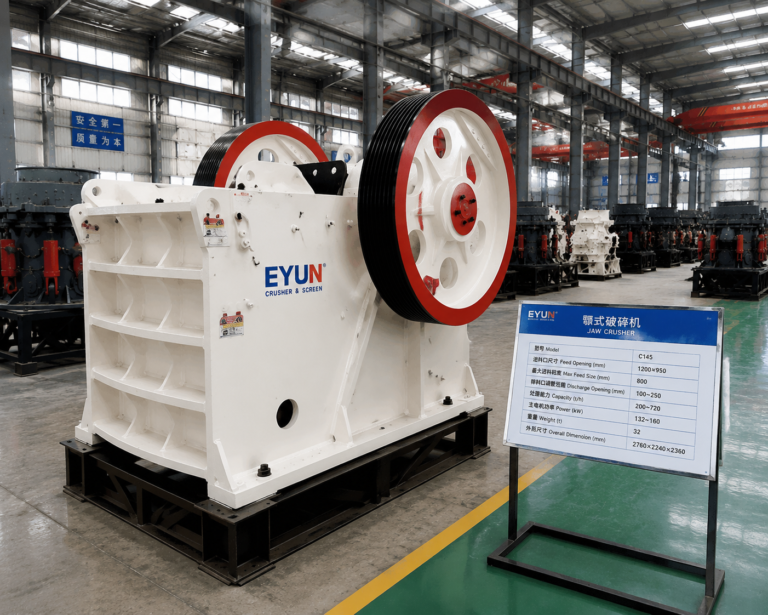
Jaw Crusher + Cone Crusher
Basalt
Very Hard
Jaw Crusher + Cone Crusher
River Stone
Hard
Jaw Crusher + Cone Crusher
Limestone
Medium
Jaw Crusher + Impact Crusher
Dolomite
Medium-Hard
Jaw Crusher + Cone Crusher
Quartz
Extremely Hard
Heavy-duty Jaw Crusher + Cone Crusher
Selecting equipment according to material properties minimizes wear, improves productivity, and reduces maintenance costs.
2. Define the Required Production Capacity
Capacity is one of the first questions engineers should determine before designing a production line.
Typical production capacities include:
50 TPH
100 TPH
150 TPH
200 TPH
250 TPH
300 TPH
500 TPH
800 TPH
1000+ TPH
Capacity should be calculated based on:
Annual production target
Working days per year
Operating hours per day
Future expansion requirements
For example:
Annual target: 600,000 tons
Working days: 300 days
Daily production: 2,000 tons
Operating time: 10 hours/day
Required capacity:
Approximately 200 TPH
Engineers usually recommend reserving an additional 10–20% production capacity to accommodate future demand and equipment maintenance.
3. Determine the Finished Product Requirements
Different customers require different aggregate sizes.
Common finished products include:
0–5 mm (manufactured sand)
5–10 mm
10–20 mm
20–40 mm
40–70 mm
If multiple products are required simultaneously, a multi-deck vibrating screen should be incorporated into the process.
Proper screening design increases product accuracy while reducing recirculation and unnecessary energy consumption.
4. Select the Appropriate Process Flow
The production process depends primarily on the material type and product requirements.
Typical Hard Rock Crushing Process
Raw Material
↓
Vibrating Feeder
↓
Jaw Crusher
↓
Cone Crusher
↓
Vibrating Screen
↓
Finished Products
This configuration is suitable for granite, basalt, river stone, and other high-hardness materials.
Advantages:
Low wear
High efficiency
Stable production
Excellent aggregate quality
Typical Limestone Production Process
Raw Material
↓
Vibrating Feeder
↓
Jaw Crusher
↓
Impact Crusher
↓
Vibrating Screen
↓
Finished Products
Impact crushers produce excellent particle shape, making them ideal for construction aggregates and concrete applications.
Sand Production Process
Raw Material
↓
Primary Crushing
↓
Secondary Crushing
↓
VSI Sand Making Machine
↓
Sand Washing Machine (Optional)
↓
Finished Sand
This process is commonly used for producing manufactured sand with excellent particle shape and grading.
5. Equipment Matching Is Critical
Each machine should match the capacity of the previous and following equipment.
For example:
The vibrating feeder should continuously supply material without overloading the jaw crusher.
The jaw crusher discharge size should match the cone crusher’s feed opening.
The vibrating screen capacity should exceed the crusher output.
Belt conveyors should be designed according to the maximum material flow.
Poor equipment matching often causes bottlenecks, excessive wear, higher energy consumption, and reduced productivity.
6. Plant Layout Design
An efficient production line depends not only on equipment selection but also on a well-planned plant layout.
A properly designed layout improves material flow, reduces operating costs, simplifies maintenance, and enhances workplace safety.
Key Layout Principles
Minimize material transfer distances.
Avoid unnecessary conveyor crossings.
Reserve sufficient space for equipment maintenance.
Design clear traffic routes for loaders and trucks.
Allow room for future capacity expansion.
Good layout planning reduces equipment downtime and increases overall plant efficiency.
7. Environmental Protection Measures
Modern mining projects must meet increasingly strict environmental regulations.
A well-designed crushing plant should include environmental protection systems from the beginning rather than adding them later.
Dust Control
Dust is generated during:
Feeding
Primary crushing
Secondary crushing
Screening
Material transfer points
Recommended dust suppression methods:
Water spray systems
Dust collection equipment
Fully enclosed transfer points
Sealed belt conveyors
Effective dust control improves working conditions while reducing environmental impact.
Noise Reduction
Noise can be reduced by:
Installing soundproof covers
Using rubber liners
Proper equipment foundation design
Regular equipment maintenance
Lower noise levels improve operator safety and comply with local environmental standards.
Wastewater Management
If sand washing equipment is used, wastewater treatment should also be considered.
Typical solutions include:
Thickener tanks
Filter presses
Water recycling systems
Many modern plants recycle over 90% of process water, significantly reducing water consumption.
8. Automation Improves Productivity
Automation has become a standard feature of modern crushing plants.
A PLC-based control system offers numerous advantages:
Centralized equipment control
Automatic start and stop sequences
Real-time production monitoring
Fault alarms
Remote diagnostics
Reduced labor requirements
Operators can monitor the entire production process from a central control room, improving efficiency and reducing operating risks.
9. Five Common Design Mistakes
Mistake 1: Insufficient Capacity Margin
Some production lines are designed exactly to the required output.
However, equipment performance naturally declines over time due to wear.
Professional engineers usually recommend reserving an additional 10–20% capacity.
Mistake 2: Poor Equipment Matching
A larger crusher does not always increase production.
If downstream equipment cannot handle the increased output, the entire production line becomes inefficient.
Capacity balancing is essential.
Mistake 3: Ignoring Maintenance Access
Maintenance should be considered during the design stage.
Each machine should have sufficient space for:
Liner replacement
Bearing maintenance
Motor servicing
Conveyor adjustment
Proper maintenance access reduces downtime and maintenance costs.
Mistake 4: Poor Conveyor Design
Conveyors are often underestimated.
Improper belt width, speed, or inclination can cause:
Material spillage
Belt deviation
Excessive wear
Reduced plant efficiency
Proper conveyor design is essential for stable production.
Mistake 5: No Future Expansion Plan
Many successful mines expand production after several years.
Leaving space for additional crushers, screens, or conveyors can significantly reduce future construction costs.
Large commercial aggregate production and mining operations.
11. Energy Efficiency and Operating Costs
Reducing energy consumption is one of the most effective ways to improve profitability.
Recommended measures include:
High-efficiency motors
Variable frequency drives (VFD)
Proper equipment matching
Optimized crushing ratios
Regular preventive maintenance
Lower energy consumption directly reduces production costs per ton.
12. Why Customized Design Matters
Every mining project is unique.
Factors such as:
Material characteristics
Climate
Site elevation
Available land
Power supply
Budget
all influence the final production line design.
For this reason, professional manufacturers typically provide customized solutions rather than standard equipment combinations.
A customized production line ensures:
Higher efficiency
Lower operating costs
Better product quality
Easier future expansion
Faster return on investment
Conclusion
Designing an efficient crushing and screening production line requires more than selecting high-quality equipment.
A successful plant combines appropriate equipment selection, optimized process flow, proper plant layout, environmental protection measures, automation technology, and long-term maintenance planning.
Investing in a professionally designed production line not only improves productivity but also reduces operating costs and maximizes long-term profitability.
Contact Us
Looking for a customized crushing and screening solution?
Our experienced engineering team can design a complete production line based on your: